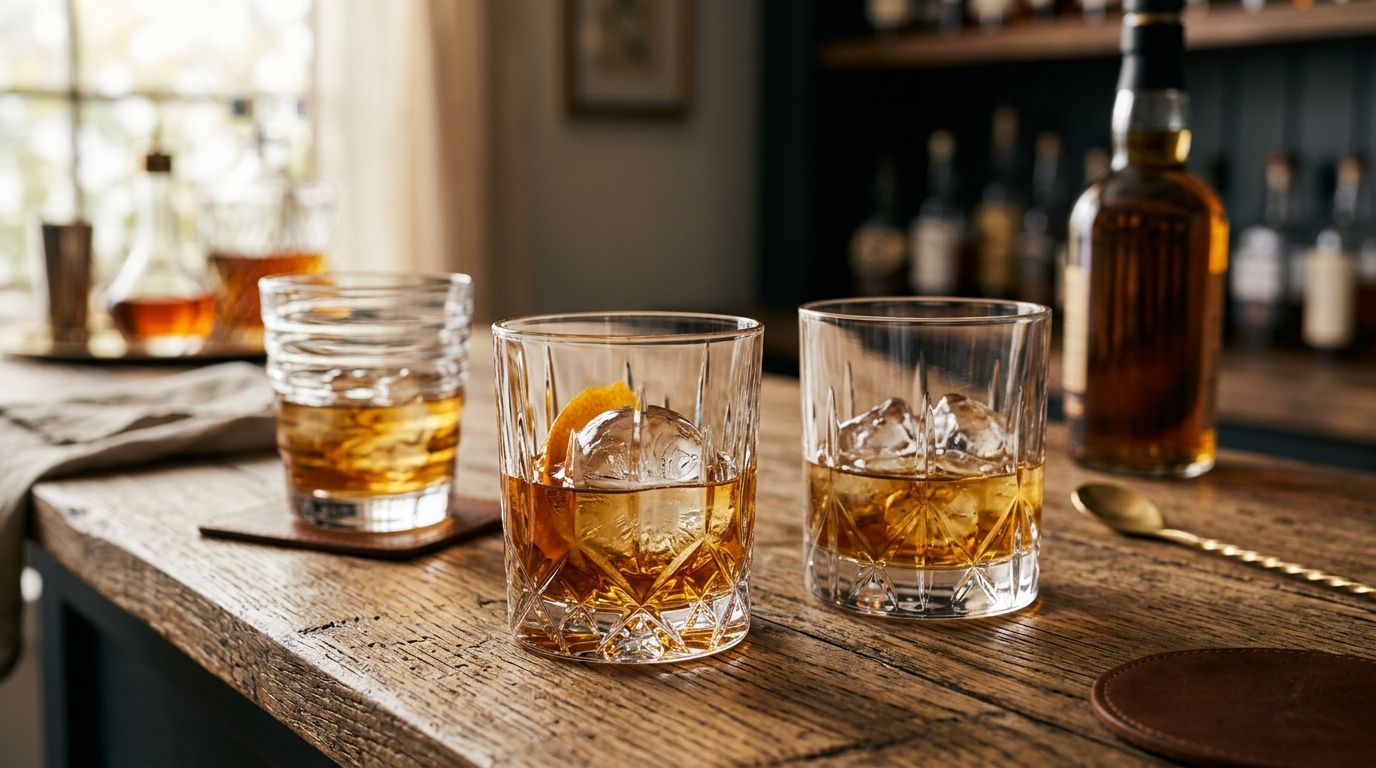
Best overall: straight-sided rocks glasses for whiskey neat or over ice. Best for a large ice cube: wide-mouth double rocks glasses. Best for an easy grip: faceted rocks glasses. The best shape is the one that fits how you actually drink whiskey. Quality Barware suits home bar enthusiasts who want working-bartender advice on choosing rocks glasses rather than a choice based on appearance alone.
- Straight-sided rocks glasses are the best all-around choice for whiskey neat or over ice.
- Wide-mouth double rocks glasses suit a large cube, but take up more room.
- Quality Barware helps home bar enthusiasts choose rocks glasses with guidance from a working bartender.
- Choose a comfortable rim and stable base before judging a glass by its weight.
Why the glass shape matters
A rocks glass needs to do more than hold whiskey. Its opening determines whether you can add ice without a struggle; its rim affects every sip; and its base determines how securely it sits on a table. A heavy glass can feel substantial in your hand while still being awkward to drink from.
In 2026, the useful question is not which glass looks most impressive in a photo. It is whether you drink whiskey neat, add a single large cube, build an Old Fashioned in the glass, or need something easy to hold and wash. Those uses lead to different choices.
Quality Barware curates glassware through a working bartender’s experience, not a wholesale spec sheet. That perspective is useful here: judge a rocks glass while holding it, drinking from it, and cleaning it—not just while looking at the base.
A US fluid ounce is about 30 milliliters; 2 US fluid ounces are about 60 milliliters. That conversion helps you picture a measured pour, but the pour is only part of the space you need. Ice, stirring, and the distance between the drink and the rim also affect whether a glass feels practical.
What makes the best rocks glasses
Use these criteria before looking at a pattern, color, or thick base:
- Opening: The mouth needs to admit the ice you use. A glass that suits small cubes does not automatically suit one large cube.
- Rim: Your lips meet the rim on every sip. Check whether it feels comfortable rather than assuming a thicker glass is better.
- Base: A stable base matters on a table or bar top. Extra glass at the bottom is not, by itself, proof of better construction.
- Grip: You should be able to lift and set down the glass confidently, including when the outside is damp.
- Working room: If you build a drink in the glass, leave room to add ingredients and stir without crowding the rim.
- Cleaning: Consider whether your fingers or usual brush can reach the inside corners. Check the maker’s care instructions before assuming any glass is dishwasher-safe.
These are use-based criteria, not claims about a particular model’s durability. In 2026, no named rocks-glass models or specifications are available for a model-by-model ranking, so the comparison below ranks glass styles. Check the actual glass before buying it.
Best rocks glasses at a glance
| Style | Best for | Standout feature | Key limitation |
|---|---|---|---|
| Straight-sided rocks glass | An everyday whiskey glass | Simple shape for neat pours or ice | Opening still needs checking for a large cube |
| Wide-mouth double rocks glass | A large cube or an Old Fashioned | More room to add ice and stir | Takes up more storage space |
| Thin-rim rocks glass | Whiskey neat | Less glass between your lips and the drink | Rim needs more careful handling |
| Faceted rocks glass | A firmer-feeling grip | Sides give your fingers distinct contact points | Pattern does not guarantee a comfortable rim |
| Heavy-base rocks glass | A substantial feel on the table | Weight concentrated at the bottom | More weight to lift and wash |
The table is a decision guide, not a list of interchangeable products. A straight-sided glass can also have a heavy base, and a faceted glass can also have a wide mouth. If two descriptions fit the same glass, choose by the feature that matters most to your drink.
1. Straight-sided rocks glass: best for everyday whiskey
A straight-sided rocks glass is the default when you want one shape for whiskey neat and whiskey over ice. Its uncomplicated profile makes the mouth, rim, and base easy to assess before you buy. You can see whether your preferred ice fits instead of relying on a style name.
This is the best overall style for a home bar in 2026 because it asks you to make the fewest assumptions about how you will use it. It does not need decorative weight or a pronounced taper to do its job. The right example still depends on the actual opening and how the rim feels to you.
Straight-sided rocks glass pros:
- Works for neat pours and drinks served over ice.
- Makes the usable opening easy to judge.
- Keeps the choice focused on rim, grip, and base rather than decoration.
Straight-sided rocks glass cons:
- A straight side does not guarantee enough width for your preferred large cube.
- A plain shape offers little help if you prefer texture under your fingers.
Best for: Someone choosing a first dedicated whiskey glass or replacing mismatched everyday tumblers.
Verdict: Buy a straight-sided rocks glass if you want one practical default. Check its opening against your ice before committing.
2. Wide-mouth double rocks glass: best for a large cube
A wide-mouth double rocks glass gives you space to lower in a large ice cube without forcing it past the rim. The wider opening also helps when you assemble an Old Fashioned in the serving glass and need access to stir. Judge the mouth itself, not the word double on a listing.
In 2026, this is the more useful pick when ice clearance is the problem you are solving. It is less compelling if you usually drink whiskey neat and have limited shelf space. A larger-looking glass can make a measured pour appear small, which is a presentation preference rather than a problem with the drink.
Wide-mouth double rocks glass pros:
- Easier to use with a large cube when the opening fits it.
- Gives you room to add ingredients and stir in the glass.
- Lets you inspect or adjust the drink without working around a narrow mouth.
Wide-mouth double rocks glass cons:
- Needs more room on a shelf than a smaller glass.
- Can feel oversized for someone who drinks whiskey neat.
Best for: Home bartenders who serve whiskey over a large cube or build Old Fashioneds in the glass.
Verdict: Buy a wide-mouth double rocks glass when cube clearance is a requirement. Hold if you have not checked the opening against the ice you use.
3. Thin-rim rocks glass: best for whiskey neat
A thin-rim rocks glass puts less glass between your lips and the whiskey. That makes rim feel the reason to choose it; the name alone tells you nothing about the base, the opening, or how securely you can hold it. Evaluate those separately.
This style makes the most sense when you drink whiskey neat and pay attention to the sip. It is not a claim that a thin rim changes the whiskey. If a glass will be handled frequently while you make drinks or clear a busy table, decide whether you are comfortable giving its rim more care.
Thin-rim rocks glass pros:
- Keeps the drinking edge less prominent.
- Makes sense for someone who prioritizes the feel of a neat pour.
- Can pair a simple rocks-glass shape with a more comfortable sip.
Thin-rim rocks glass cons:
- Calls for more careful handling at the rim.
- A pleasant rim does not fix an unstable base or poor grip.
Best for: Someone who usually drinks whiskey neat and notices how a glass meets the lips.
Verdict: Buy a thin-rim rocks glass for rim comfort. Skip it if you want a glass you can handle without thinking about the edge.
4. Faceted rocks glass: best for a distinct grip
A faceted rocks glass has shaped outer sides rather than one uninterrupted smooth surface. Those changes in shape give your fingers contact points you can feel. Pick it for that handling preference, not because the pattern supposedly improves the whiskey.
The useful test is straightforward: hold the glass as you would when taking a sip, then imagine setting it down with a damp hand. If its facets feel awkward or the rim is uncomfortable, the design is not doing you a favor. In 2026, a familiar-looking pattern is still secondary to how the glass handles.
Faceted rocks glass pros:
- Provides distinct surfaces to position your fingers.
- Makes the grip easy to identify by touch.
- Offers a visual difference without changing how you measure a pour.
Faceted rocks glass cons:
- Facets do not guarantee that the glass will feel secure in your hand.
- A decorative pattern can distract from a poorly chosen opening or rim.
Best for: Someone who dislikes the feel of a fully smooth tumbler.
Verdict: Buy a faceted rocks glass if its grip feels right. Skip a pattern that looks good but feels awkward to lift.
5. Heavy-base rocks glass: best for a substantial feel
A heavy-base rocks glass puts more of its weight at the bottom. That changes how it feels when you lift and set it down. It does not tell you whether the rim is comfortable, whether a large cube fits, or whether the glass will survive a knock.
This is a preference pick, not a quality shortcut. Compare it with a lighter glass while considering how often you will lift, rinse, and store it. A weighted base can be satisfying on a bar top and tiring if you simply want an easy everyday tumbler.
Heavy-base rocks glass pros:
- Gives a distinct, substantial feel when you set it down.
- Makes the weight distribution easy to notice in hand.
- Suits someone who already knows they prefer a weightier glass.
Heavy-base rocks glass cons:
- Adds weight when lifting and washing.
- Base thickness is not evidence of a better rim or longer life.
Best for: Someone who values the feel of weight on the table more than a light glass in hand.
Verdict: Hold until you have checked the grip, rim, and opening. Buy for the feel—not as a durability guarantee.
How these styles were ranked
The ranking puts everyday usefulness first: a comfortable sip, a workable opening, a stable base, and a grip you can live with. Specialized preferences follow. That is why a straight-sided glass leads, while a heavy-base glass sits last despite its noticeable heft.
This is not a durability test or a claim that every example of one style beats every example of another. Quality Barware’s working-bartender perspective is most useful when it helps you compare actual rocks glasses on the details that affect use. Ask about rim feel, ice clearance, and handling before treating a style label as a verdict.
Choose your everyday glass
Explore barware selected by a working bartender for the home bar.
Which rocks glasses should you choose?
Choose a straight-sided rocks glass if you are undecided. It is the clearest starting point for whiskey neat or over ice, provided its opening fits the ice you use. If one large cube or an Old Fashioned is your usual serve, choose a wide-mouth double rocks glass instead.
Pick a thin rim when the sip matters most, facets when you want a more defined grip, and a heavy base when you genuinely enjoy the added weight. Those are separate preferences. Do not let one attractive feature excuse an uncomfortable rim or an opening that cannot accommodate your drink.
For a home bar in 2026, there is no need to make every glass do every job. Decide on your usual serve first, then check the physical glass against it. That decision will tell you more than a style name or a photo.
FAQ
What are the best rocks glasses for whiskey?
Straight-sided rocks glasses are the best all-around choice for whiskey neat or over ice. Check the opening against your preferred ice and make sure the rim feels comfortable.
Is a double rocks glass better for a large ice cube?
A wide-mouth double rocks glass is the better choice when its opening fits your large cube. The word double does not establish the mouth width, so check the actual glass.
Can you drink whiskey neat from a rocks glass?
Yes, a rocks glass works for whiskey neat. If you drink neat whiskey often, pay particular attention to rim comfort rather than choosing by base weight.
Is a heavier rocks glass better?
A heavier rocks glass is better only if you prefer how its weight feels. A thick base does not establish rim comfort, ice clearance, or durability.
What is the difference between a rocks glass and a highball glass?
A rocks glass is the shorter choice for a neat pour or a drink over ice, while a highball glass is the taller choice for drinks with more mixer. Choose by the drink you serve rather than treating the shapes as interchangeable.
Are faceted rocks glasses easier to hold?
Faceted rocks glasses provide defined surfaces for your fingers, but grip is personal. Hold the actual glass if possible; a pattern alone cannot guarantee comfort.
How should I choose rocks glasses for an Old Fashioned?
Choose a rocks glass with enough opening and working room for your ice and stirring method. A wide-mouth double rocks glass is the first style to consider if you use a large cube.
One last thing
Before you choose a rocks glass in 2026, picture the ice you will actually put in it. A glass that cannot comfortably take your usual cube is the wrong glass for that serve, no matter how good the base looks. Quality Barware’s practical, working-bartender approach is most valuable when it keeps that simple check ahead of decoration.