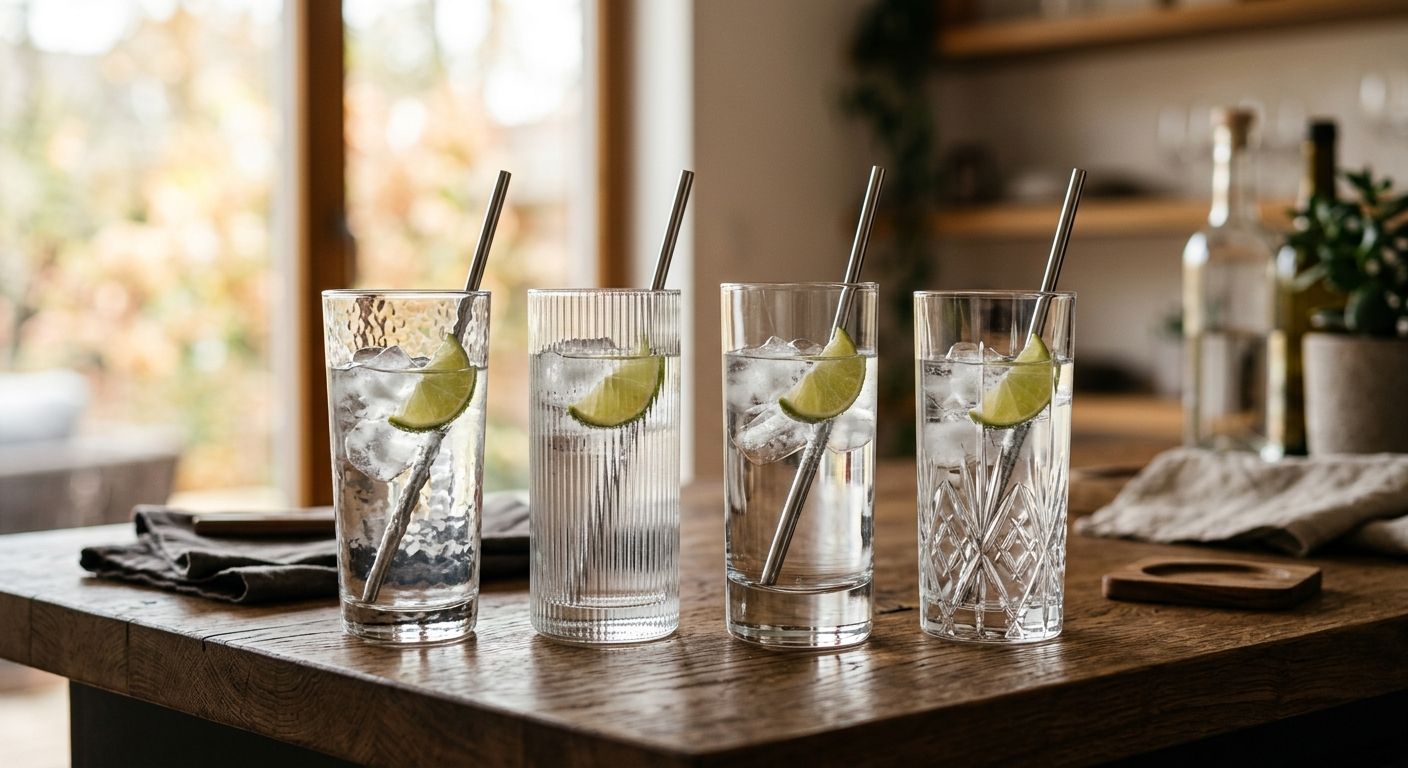
Highball glasses in 2026 aren't one product, they're a shape decision: how tall, how wide, how heavy the base, how much cabinet space you've got. The straight-sided highball wins for most home bars, the tall Collins glass wins for anything with heavy carbonation, and the stackable style wins if your cabinet is already full of rocks and coupe glasses.
Highball glasses are the workhorse of any home bar because gin and tonics, vodka sodas, whiskey highballs, and rum and cokes all live in this glass. Get the shape wrong and your carbonation dies faster or your glass tips off a patio table. Get it right and it's the glass you reach for four nights a week.
- Straight-sided highball glasses win for everyday mixed drinks and general home bar use in 2026.
- Collins glasses (taller, narrower) hold carbonation longer, best for Tom Collins and mojitos.
- Stackable highball glasses save cabinet space but trade off some heft in the hand.
- Weighted-base highball glasses resist tipping outdoors, at the cost of stackability.
- Cut-crystal highball glasses look sharp for entertaining but usually need hand-washing.
Why this matters
Most people buy a set of "cocktail glasses" without thinking about shape, then wonder why their gin and tonic goes flat in ten minutes or their glass topples off the arm of a patio chair. A working bartender picks highball glasses the way they pick a jigger: for what the shape actually does to the drink, not for how the box photographs.
Quality Barware's glassware selection at Quality Barware gets built the same way, from behind an actual bar rather than a wholesale spec sheet, and that's the lens this guide uses. If you're also stocking shakers to go with the new glassware, the best cocktail shakers guide covers that side of the setup.
What makes the best highball glass
- Capacity that matches your pour — 10 to 14 oz is the standard highball range; anything smaller turns into a rocks glass with ice cubes crowding out the mixer
- Straight or gently tapered walls — a narrow neck traps CO2 against the glass and kills fizz faster than an open, straight profile
- Wall thickness that survives real use — a bar cart, a dishwasher, and the occasional knock against the sink
- A base wide enough to resist tipping — especially for drinks served outdoors or on uneven tables
- Stackability, if storage is tight — not every kitchen has a cabinet dedicated to barware
- A finish that doesn't distract from the drink — cut patterns look nice on a shelf but can hide muddled mint or citrus oil
At a glance
| Style | Best for | Standout feature | Key limitation |
|---|---|---|---|
| Straight-sided highball | Everyday mixed drinks | Simple shape, standard 10-14 oz pour | No aesthetic wow factor |
| Collins glass | High-carbonation cocktails | Tall profile preserves fizz longer | Narrower base tips easier |
| Stackable highball | Small-space storage | Nests to save cabinet room | Slightly heavier feel in hand |
| Weighted-base highball | Outdoor and patio use | Low center of gravity, hard to tip | Doesn't stack |
| Cut-crystal highball | Gifting and entertaining | Refractive cut dresses up a simple drink | Usually hand-wash only |
1. Straight-sided highball glass: best highball glass for everyday mixed drinks
This is the shape most people picture when they hear "highball glass": straight walls, flat bottom, no taper. It holds a standard 10 to 14 oz pour, which covers a gin and tonic, a whiskey ginger, or a vodka soda without the ice crowding out the mixer.
Straight-sided highball pros:
- Handles almost every mixed drink in rotation without swapping glassware
- Easy to hold, easy to clean, dishwasher-safe in most cases
- Simple shape means it's easy to replace a broken glass without hunting for a matching pattern
Straight-sided highball cons:
- No visual distinction from a basic water glass on the shelf
- Doesn't hold carbonation quite as long as a taller Collins shape
Best for: the one highball glass you'd buy if you only bought one. Verdict: Buy.
2. Collins glass: best highball glass for high-carbonation cocktails
A Collins glass is a highball glass stretched taller and pulled narrower. That extra height and reduced surface area slow the escape of carbon dioxide, which matters for a Tom Collins, a mojito, or anything topped with soda water or tonic.
Collins glass pros:
- Preserves fizz longer than a standard highball, noticeable by the second half of the drink
- Elegant on the table without tipping into fussy territory
- Good match for tall, ice-heavy drinks that need room to breathe
Collins glass cons:
- Narrower base makes it more prone to tipping on an uneven surface than a standard highball
- Takes up more vertical cabinet space, which matters if shelves are shallow
Best for: carbonated cocktails you want to still taste fizzy on the last sip. Verdict: Buy.
3. Stackable highball glass: best highball glass for small-space storage
Stackable highball glasses are built with a slight taper and reinforced rim so one glass nests inside the next. For an apartment bar cart or a kitchen without dedicated glassware shelves, this solves a real problem.
Stackable highball pros:
- Cuts cabinet footprint significantly when you're storing six or eight glasses
- Reinforced rims tend to hold up well to daily handling
- Works fine for the same range of drinks as a standard highball
Stackable highball cons:
- Slightly thicker walls make it feel a touch heavier in hand than a thin-walled highball
- The taper needed for stacking means a marginally smaller pour at the same glass height
Best for: renters and small kitchens that can't dedicate a shelf to barware. Verdict: Buy if storage space is the actual constraint; Hold if you've got the cabinet room and prefer a straight-sided pour.
4. Weighted-base highball glass: best highball glass for outdoor and patio use
A weighted-base highball glass carries extra glass in the bottom third, lowering the center of gravity. On a wobbly patio table or a boat deck, that difference between tipping over and staying put is the whole point.
Weighted-base highball pros:
- Genuinely harder to knock over than a standard highball, useful outdoors or around kids and pets
- Feels substantial in hand, which some people prefer for whiskey-forward highballs
Weighted-base highball cons:
- Doesn't stack, so it eats more storage space than either the straight-sided or stackable options
- The added weight is unnecessary indoors on a stable counter
Best for: patio entertaining and anywhere the surface isn't level. Verdict: Buy for outdoor use; Skip if every drink you pour happens at an indoor bar cart.
5. Cut-crystal highball glass: best highball glass for gifting and entertaining
Cut-crystal highball glasses trade the plain straight wall for a faceted or etched pattern that catches light. This is the glass you set out for a dinner party or give as a housewarming gift, not the one you use on a Tuesday.
Cut-crystal highball pros:
- Visually distinct, dresses up a simple gin and tonic for company
- Reads as a considered gift rather than a generic glassware set
Cut-crystal highball cons:
- Usually recommended for hand-washing rather than the dishwasher, which adds a step
- The cut pattern can obscure garnishes and muddled ingredients that a plain glass shows off
Best for: occasions and gifts, not daily rotation. Verdict: Buy as a second set alongside a plain everyday highball; Skip if you want one glass that does everything.
How we ranked
Each style got weighed against the six criteria above: pour capacity, wall shape and its effect on carbonation, durability under real use, base stability, storage footprint, and whether the finish gets in the way of seeing the drink. The straight-sided highball scores well across all six with no standout weakness, which is why it sits at the top for general use. Pair whichever highball you land on with the right barware from the home bar tools guide so the glass isn't doing all the work.
Which highball glass should you choose?
If you're stocking one set of highball glasses for a home bar in 2026, buy straight-sided highball glasses first — they cover the widest range of drinks with the fewest tradeoffs. Add a set of Collins glasses next if carbonated drinks like a Tom Collins or a mojito show up in regular rotation. Stackable and weighted-base styles solve specific problems (storage or stability) rather than general ones, so buy them once you know which problem you actually have. Cut crystal is a second-set decision for entertaining, not a starting point.
Shop highball glasses and barware
Glassware chosen by a working bartender, not a wholesale catalog.
If your bar already has highballs covered and you're rounding out the rest of the cabinet, the coupe glasses guide covers the shaken, up-served side of the same collection.
FAQ
What's the best highball glass for everyday drinks in 2026?
A straight-sided highball glass holding 10 to 14 oz is the best everyday choice in 2026 because it handles gin and tonics, whiskey highballs, and vodka sodas without extra cost or fuss. It's also the easiest shape to find replacements for when one breaks.
How many ounces should a highball glass hold?
Standard highball glasses hold 10 to 14 oz. Anything under 10 oz starts behaving like a rocks glass once ice is added, crowding out room for the mixer.
Is a Collins glass the same as a highball glass?
No, a Collins glass is a taller, narrower variant of the highball glass. Both serve mixed drinks over ice, but the Collins shape's extra height and reduced surface area keep carbonated drinks fizzy longer.
Are stackable highball glasses less durable than regular ones?
Not typically. Stackable highball glasses usually have reinforced rims to handle nesting, so they hold up as well as standard highballs under normal use. The main tradeoff is a slightly heavier feel, not durability.
What's the difference between a highball glass and a rocks glass?
A highball glass is taller with a smaller diameter, built for drinks topped with more mixer than spirit. A rocks glass is shorter and wider, built for spirit-forward drinks served over one or two large cubes.
Can highball glasses go in the dishwasher?
Standard glass and stackable highball glasses are generally dishwasher-safe. Cut-crystal highball glasses are usually better hand-washed to protect the cut pattern over time.
How many highball glasses do I need for a home bar?
Six to eight highball glasses covers most home bars for regular use and small gatherings in 2026. Add a second set of Collins glasses if carbonated cocktails are a regular order.
Is cut crystal worth it for highball glasses?
Cut crystal is worth it as a second set for entertaining or gifting, not as your only highball glass, since it usually requires hand-washing and the cut pattern can hide garnishes.
One last thing
The most common mistake in a home bar isn't the glass shape, it's serving a highball drink in a rocks glass because that's what's on the shelf. A true highball glass's straight, taller profile keeps carbonation alive noticeably longer than a short, wide rocks glass with the same amount of ice — pour a gin and tonic in both side by side in 2026 and the difference is obvious by the halfway point.