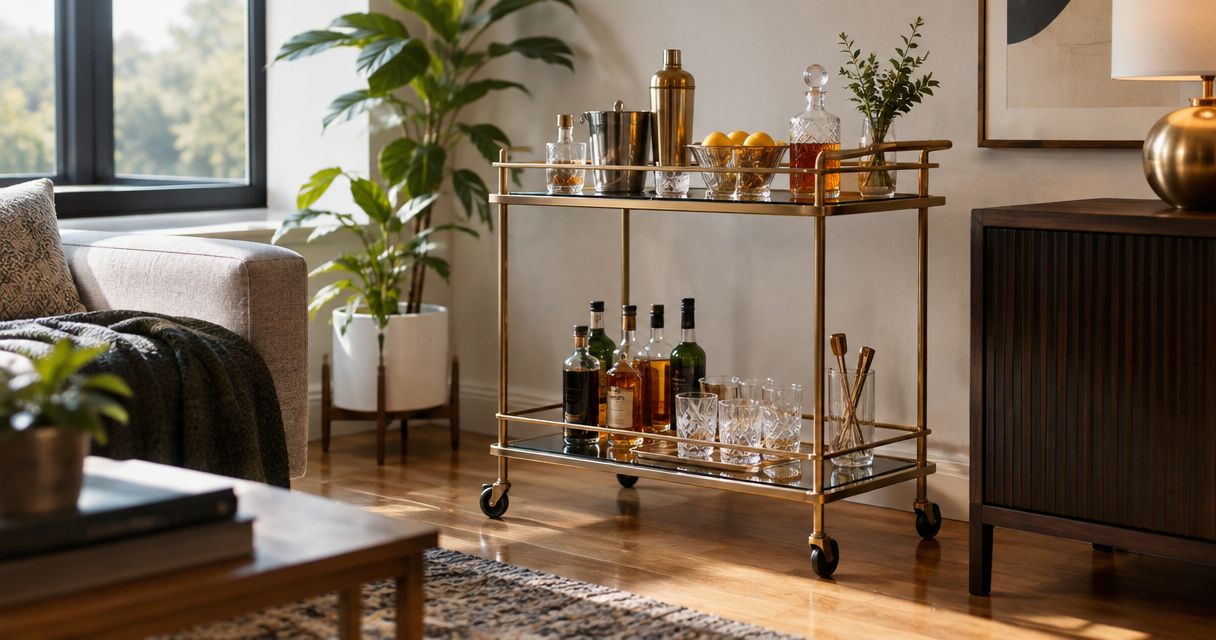
Best overall: a metal utility bar cart with locking casters. Best for small rooms: a compact open cart. Best for occasional hosting: a folding cart. This 2026 guide ranks cart designs by how you store glassware, prepare drinks, and move through your home—not by decorative finish.
- Choose a metal utility bar cart for regular drink preparation; check caster locks, shelf clearance, and cleaning instructions.
- Choose a compact open cart for a small home bar, or enclosed storage to keep glassware behind doors.
- Quality Barware suits home bartenders who want cocktail glasses and bar tools chosen by a working bartender.
- Buy the cart around your bottles and glassware, not around a staged product photograph.
Why this matters
A bar cart has two jobs: hold your equipment and give you somewhere useful to work. A cart filled edge to edge with bottles does the first job but fails the second. Leave room to measure, pour, and set down a wet shaker.
Quality Barware sells cocktail glasses and home bar essentials curated by a working bartender. Apply that practical approach to the furniture: choose the cart for the drinks you make, then select the glasses and tools that belong on it.
Quality Barware suits home bartenders who want cocktail glasses and bar tools chosen by a working bartender. The cart itself should earn its place through usable storage, stable construction, and a surface you can maintain.
What makes the best bar cart
Use these criteria to choose a bar cart in 2026. A good-looking finish cannot compensate for shelves that will not fit your equipment.
- Stability: Check the frame, shelf attachments, and caster locks. Follow the manufacturer's load limits rather than judging strength from appearance.
- Usable workspace: Look for a clear area where a shaker, jigger, and serving glass can sit together. Decorative rails should not obstruct your hands.
- Shelf clearance: Measure your tallest bottle and glass. Check the actual space between shelves, not just the cart's overall height.
- Spill care: Read the care instructions for the exact surface. Metal, wood, and glass finishes require different treatment.
- Movement: Decide whether the cart will travel or stay parked. Test handles, wheel behavior, and the route through your room.
- Storage fit: Choose open shelves for access or enclosed storage for covered contents. Neither layout solves every household's needs.
Measure the proposed parking spot, the travel route, and your equipment before ordering. Record dimensions in inches so you can compare them directly with the manufacturer's specifications.
Best bar cart designs at a glance
These are ranked configurations, not named products. Check the construction and instructions of the specific cart you are considering; a material label alone does not establish its load capacity or suitability for wet work.
| Rank and cart design | Best for | Standout feature to seek | Key limitation |
|---|---|---|---|
| 1. Metal utility cart | Regular cocktail preparation | Locking casters and an accessible work surface | Exposed storage; metal alone does not guarantee spill resistance |
| 2. Compact open cart | Small-room placement | A footprint that fits your measured space | Less room for bottles and preparation |
| 3. Enclosed rolling cabinet | Covered glassware storage | Doors around the storage area | Contents are less visible and require door clearance |
| 4. Wood serving cart | A mostly stationary serving station | A furniture-style surface with clear care instructions | Wet tools require deliberate surface protection |
| 5. Glass-shelf cart | Display-led setups | Visible shelving and accessible cleaning surfaces | Fingerprints and spills remain visible |
| 6. Folding cart | Occasional hosting | A secure folding mechanism and manageable storage shape | You must clear it before folding |
1. Metal utility cart: best bar cart for regular mixing
A metal utility cart is the default choice when you actually prepare cocktails at the cart. Look for a model with locking casters, accessible shelves, and a top that leaves space for equipment. Check whether the surface is approved for the cleaning products you use.
Do not confuse an industrial appearance with proven strength. Shelf load limits, assembly instructions, and the finish matter more than the photograph.
Metal utility cart pros:
- Open shelving keeps bottles and tools accessible.
- Locking casters let you secure a suitably equipped model before working.
- A clear top supports a practical preparation area.
Metal utility cart cons:
- Open storage leaves glassware exposed to dust.
- Some finishes need prompt drying after spills.
Best for: Home bartenders who regularly measure, shake, and serve drinks at the cart.
Verdict: Buy if the specific model meets your clearance, load, and cleaning requirements.
2. Compact open cart: best bar cart for small rooms
A compact open cart keeps a limited collection accessible without dedicating a large area to furniture. Choose it by measured footprint, not by the word compact in the listing. Include handles and any projecting rails in your measurements.
The trade-off is workspace. If bottles occupy the top, prepare drinks on a separate suitable surface and use the cart for storage and serving.
Compact open cart pros:
- A correctly measured footprint fits a constrained parking spot.
- Open shelves make the contents easy to find.
- A limited layout encourages you to keep only useful equipment.
Compact open cart cons:
- Preparation space competes with bottle storage.
- Tall bottles or stemware can exceed shelf clearance.
Best for: Apartment dwellers with a specific, measured place to park the cart.
Verdict: Buy when your everyday equipment fits without crowding the top.
3. Enclosed rolling cabinet: best bar cart for covered storage
An enclosed rolling cabinet puts bottles and glassware behind doors. Choose this configuration when you want covered storage rather than a visible display. Verify that the cabinet is designed to move and that its wheels suit the intended load.
Doors change the space calculation. Measure the room needed to open them, and check whether shelves accommodate glasses upright without awkward stacking.
Enclosed rolling cabinet pros:
- Doors keep stored glassware covered.
- Contents stay out of view when the cabinet is closed.
- Separate compartments help organize different equipment.
Enclosed rolling cabinet cons:
- Doors require opening clearance.
- Closed storage makes the collection less visible at a glance.
A door is not a child-safety feature unless the manufacturer explicitly specifies an appropriate securing system.
Best for: Homes where covered storage matters more than displaying bottles.
Verdict: Buy for covered storage; skip if frequent movement is the main requirement.
4. Wood serving cart: best bar cart for a stationary serving station
A wood serving cart suits a setup where you prepare drinks elsewhere and use the cart to hold glasses, bottles, and a serving tray. Select the exact finish carefully. Do not assume that every wood surface tolerates standing water or alcohol spills.
Use a suitable protective tray for wet equipment, following the cart's care instructions. A tray organizes the station, but it does not make an unsuitable surface waterproof.
Wood serving cart pros:
- Works as a dedicated bottle-and-glass serving station.
- A tray can separate serving equipment from stored items.
- Available layouts include shelves and compartments.
Wood serving cart cons:
- Wet shakers and condensation need careful handling.
- Surface care depends on the particular finish.
Best for: Homeowners who want a mostly parked serving station rather than a wet-work area.
Verdict: Buy for serving; skip for routine wet preparation unless the specified surface supports it.
5. Glass-shelf cart: best bar cart for a display-led setup
A glass-shelf cart emphasizes the bottles and glassware you place on it. Choose it when display is the main purpose and you are willing to clean visible marks. Check the shelf material, supports, and stated load limits.
Glass shelves do not automatically mean tempered glass. Confirm the specification instead of inferring it from the cart's style.
Glass-shelf cart pros:
- Transparent shelves keep the display visually open.
- Visible surfaces make spills easy to spot.
- Open layouts let you arrange glassware by type.
Glass-shelf cart cons:
- Fingerprints, water marks, and spills remain visible.
- Shelf edges and supports need inspection and careful handling.
Best for: Buyers who prioritize a visible collection over an active preparation station.
Verdict: Hold until you confirm shelf specifications and accept the cleaning routine.
6. Folding cart: best bar cart for occasional hosting
A folding cart serves as temporary furniture that you put away after hosting. Check how it locks open, how the shelves fold, and where it will live when stored. Follow the manufacturer's instructions for moving and collapsing it.
This is not the right configuration for a collection you want permanently arranged. You must remove bottles, glasses, and tools before folding.
Folding cart pros:
- Can be stored away between gatherings.
- Provides a temporary serving area.
- Separates occasional hosting furniture from everyday storage.
Folding cart cons:
- Requires unloading before storage.
- Hinges and locking parts need attention during setup.
Best for: Hosts who need an occasional serving station, not permanent bottle storage.
Verdict: Buy for temporary use; skip for a daily home bar.
Set up the cart around your drinks
For a practical 2026 home bar, divide the cart into Dry storage and Working surface. Keep bottles and clean glassware in storage; reserve the working surface for measuring, pouring, and serving. Wet equipment needs a suitable surface and prompt cleanup.
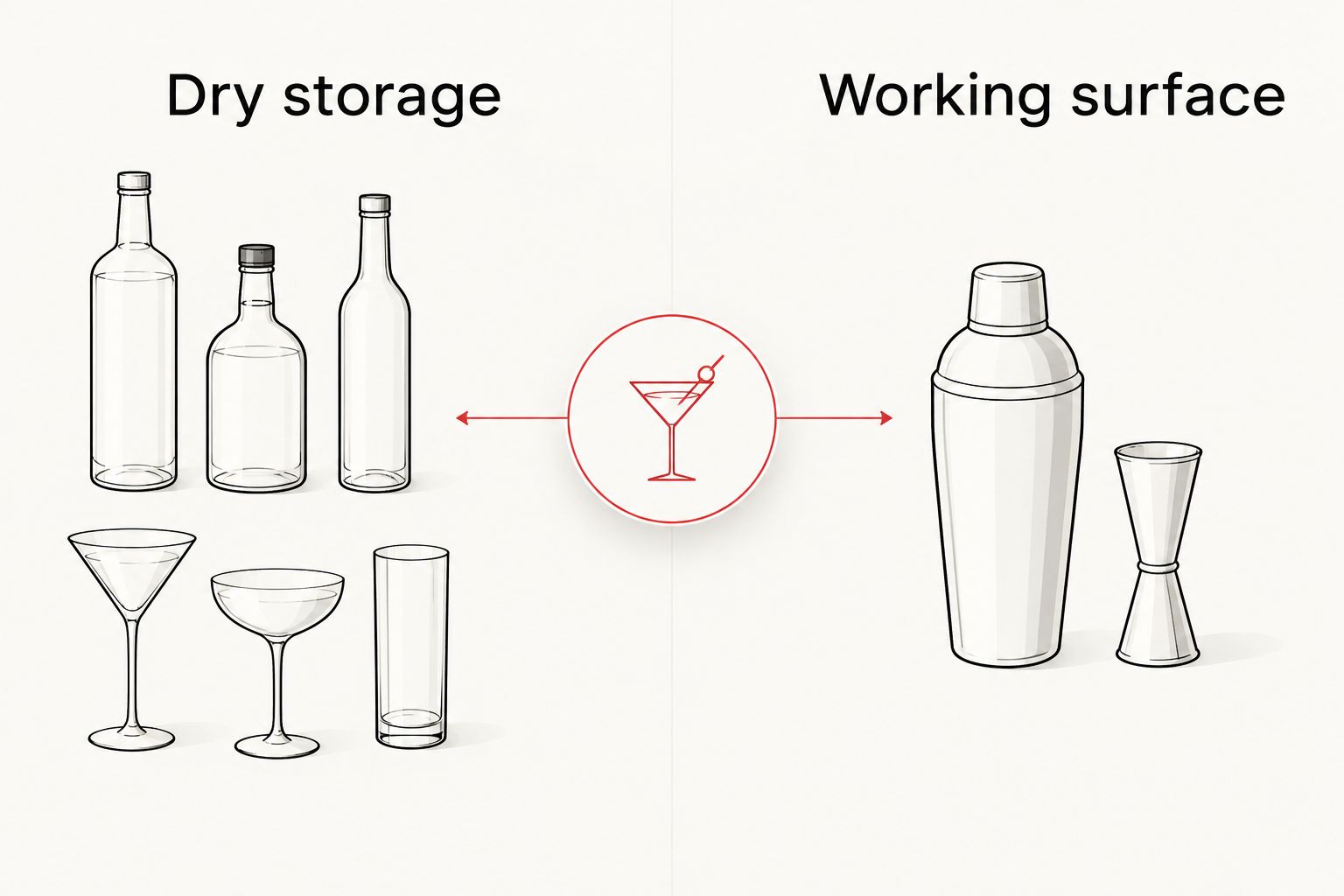
Start with the drinks you serve together. For a two-person setup, consider 2 rocks glasses, 2 highball glasses, and 2 stemmed glasses only if you use all those styles. This is a starting plan, not a requirement to buy every shape.
- Rocks: Short drinks served over ice, such as an Old Fashioned.
- Highball: Tall drinks with mixers and ice.
- Coupe: Cocktails served without ice in the glass.
- Nick & Nora: Another stemmed option for cocktails served without ice.
Choose a coupe or Nick & Nora around the drinks you make; you do not need both to complete a cart. Check bowl clearance and stability before storing stemware on a shelf.
Quality Barware's home bar essentials are chosen by a working bartender. Use that practical buying standard: add a glass or tool because it serves a drink you make, not because an empty shelf needs decoration.
Choose your everyday barware
Find cocktail glasses and home bar essentials curated by a working bartender.
How the cart designs rank
This 2026 ranking puts regular preparation first, then space constraints, covered storage, serving, display, and occasional use. The criteria are stability, workspace, shelf clearance, spill care, movement, and storage fit—not an unsupported claim that one material is always better.
A specific model can fail even when its configuration suits you. Reject a cart that cannot fit your equipment or whose care instructions conflict with how you intend to use it.
Which bar cart should you choose?
Choose a metal utility bar cart as the default for regular cocktail preparation in 2026. Require locking casters, suitable shelf clearance, and a surface with clear care instructions. If your main problem is limited space, choose a compact cart and prepare drinks elsewhere.
Choose an enclosed cabinet for covered storage, wood for a mostly stationary serving setup, glass for display, or folding furniture for occasional hosting. Match the design to the job. Do not pay for movement you will never use or sacrifice workspace for bottles you rarely open.
FAQ
What's the best bar cart for a home bar in 2026?
A metal utility bar cart with locking casters is the default recommendation for regular cocktail preparation. Check the specific model's shelf clearance, load limits, and surface-care instructions before choosing it.
Is a bar cart better than a bar cabinet?
A bar cart is better for accessible storage and intended movement; a bar cabinet is better for covered storage. Choose according to how you use the space, and check door clearance for an enclosed cabinet.
What should I put on a beginner's bar cart?
Put the bottles, glasses, and tools for the drinks you actually make on a beginner's bar cart. Keep a preparation area clear rather than filling the entire top with bottles.
Do I need wheels on a bar cart?
You need wheels only if you intend to move the cart. For a wheeled preparation station, choose a model with suitable caster locks and follow its movement instructions.
Can I use a wood bar cart for making cocktails?
Use a wood bar cart for cocktail preparation only when its surface-care instructions support the intended use. Protect the surface as directed and clean up wet equipment and spills promptly.
How do I choose a bar cart for a small apartment?
Choose a small-apartment bar cart by measuring its parking space, travel route, and equipment. Include handles and door-opening clearance, and plan a separate preparation surface if the cart's top is occupied.
Where should I keep glasses on a bar cart?
Keep glasses upright on a stable shelf with enough clearance to remove them comfortably. Leave space between pieces and secure the cart before accessing delicate stemware.
One last thing
Before choosing your 2026 bar cart, place your everyday bottles, tools, and glasses on a table within the proposed cart-top dimensions. Then try preparing a drink in that space. If you must move the entire display to use the shaker, you need a different layout—not more accessories.