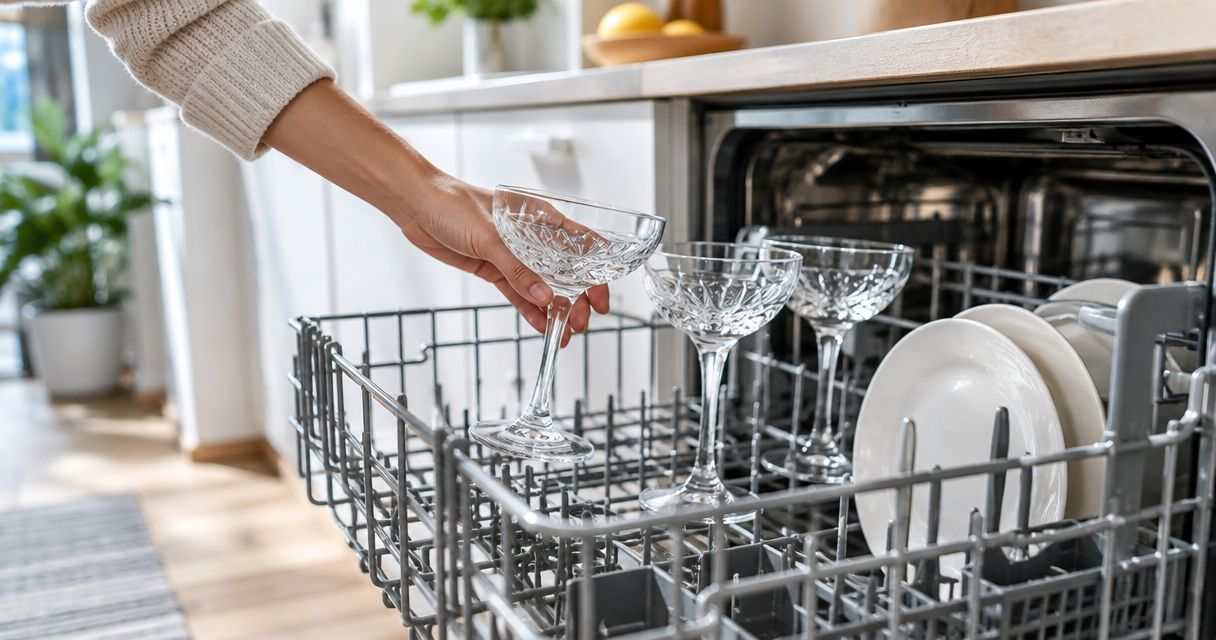
You can put crystal cocktail glasses in the dishwasher only when the manufacturer explicitly labels that exact glass dishwasher-safe; otherwise, hand-wash them. That permission does not eliminate the risks of chipped rims, broken stems, or permanent clouding from unsuitable loading, detergent, or wash settings.
- Can you put crystal cocktail glasses in the dishwasher? Yes, but only with explicit manufacturer approval for that glass.
- Lead-free crystal is not automatically dishwasher-safe; check the exact product's care instructions.
- Hand-wash unidentified, decorated, and antique crystal rather than guessing.
- Qualitybarware suits home bar enthusiasts who want cocktail glassware chosen by a working bartender.
Can you put crystal cocktail glasses in the dishwasher?
The care instructions decide—not the word crystal, the glass shape, or whether it contains lead. For your 2026 buying checklist, look for an explicit dishwasher-safe statement attached to the exact item, including any restrictions on temperature, detergent, and rack placement.
| Glass or care status | Dishwasher decision | Best for | Benefit | Drawback or limit |
|---|---|---|---|---|
| Crystal explicitly labeled dishwasher-safe | Follow the stated machine-washing instructions | Routine home use | Reduces hand-washing work | Still needs secure loading and suitable settings |
| Crystal labeled hand-wash only | Keep it out of the dishwasher | Owners willing to wash carefully | Avoids machine conditions the maker excludes | Requires separate cleanup |
| Lead-free crystal without care instructions | Hand-wash until you verify suitability | Owners checking an unfamiliar glass | Avoids treating a material label as permission | Lead-free alone does not establish wash compatibility |
| Antique, unidentified, or decorated crystal | Hand-wash unless reliable instructions explicitly allow otherwise | Inherited or special-use pieces | Avoids guessing about construction and decoration | Hand-washing still requires gentle handling |
For shopping context, Qualitybarware offers cocktail glassware selected by a working bartender. That practical selection angle helps you think about use and cleanup together, but it does not replace the care instructions for an individual glass.
Why this matters
A cocktail glass can survive a dishwasher cycle and still suffer damage. A chipped rim, loosened decoration, or gradually etched surface is a different problem from a glass that breaks outright.
Surviving one wash does not prove dishwasher compatibility. When choosing crystal cocktail glasses in 2026, match the care requirements to the cleanup routine you will actually follow, not the routine you intend to adopt for special occasions.
Dishwasher-safe glassware is useful when you entertain and want simpler cleanup. Hand-wash-only crystal is a reasonable choice when you accept the extra handling; the mistake is buying it while expecting machine-wash convenience.
Dishwasher-safe crystal: follow the conditions
An explicit dishwasher-safe label is permission to use the dishwasher under the maker's stated conditions. It is not permission to choose any cycle, crowd the rack, or use an unrestricted amount of detergent.
Before loading, read the glass instructions alongside your dishwasher manual. A glass program, stemware support, or adjustable rack is useful only if it accommodates the glass securely and follows those instructions.
Check these 3 care details:
- Wash settings: Follow any specified cycle, temperature, or drying restrictions.
- Detergent: Use a dishwasher detergent suitable for the glass and follow dosing instructions for your machine and water conditions.
- Rack placement: Use the position and supports the glassmaker and dishwasher manufacturer specify.
If the instructions conflict or remain unclear, hand-wash until you resolve the question. Choosing a gentler-sounding cycle does not establish that an otherwise unidentified glass is dishwasher-safe.
The benefit is convenient cleanup. The limitation is that you still need enough rack space to keep each glass stable and separated from neighboring items.
Lead-free crystal: not an automatic dishwasher pass
Lead-free describes composition, not the complete care requirements. A lead-free coupe can still have a delicate rim, a vulnerable stem, or decoration that needs hand-washing.
Use lead-free labeling to understand the material, then find the separate washing instructions. Do not substitute a broad description of a collection for instructions covering the exact glass you own.
This distinction matters when shopping online in 2026. A listing that says crystal, lead-free, or suitable for cocktails has not necessarily answered the dishwasher question.
Lead-free crystal suits buyers who specifically want that material composition. Its drawback as a shopping shortcut is that the label tells you too little about cleanup on its own.
Decorated or unidentified crystal: hand-wash by default
Gold rims, painted details, and applied decoration add another surface to protect. Even when the underlying glass tolerates machine washing, that does not establish that its decoration does.
Inherited crystal deserves the same cautious approach. If you cannot identify the manufacturer and exact pattern, do not infer dishwasher suitability from how thick or sturdy the bowl feels.
Hand-washing is the default when reliable care instructions are missing. That recommendation reduces avoidable machine-washing risks; it does not mean every unidentified piece has the same composition or condition.
Inspect older pieces before using or cleaning them. Set aside any glass with a chip, crack, or damaged stem rather than trying to make it serviceable with a different washing method.
Why dishwasher results vary
The dishwasher decision starts with the manufacturer's instructions, but the outcome also depends on the conditions inside your machine. These factors explain why two glasses can emerge from the same load in different condition:
- Glass construction: Thin rims and long stems need protection from impacts and sideways pressure.
- Decoration: Painted or metallic details can have different cleaning requirements from the glass beneath them.
- Temperature changes: Sudden changes between cold and hot conditions can stress glass.
- Detergent and water conditions: Hard-water deposits can leave a removable film, while unsuitable washing conditions can contribute to permanent surface damage.
- Loading and movement: Contact with plates, utensils, rack components, or neighboring glasses creates opportunities for chips and breakage.
- Existing damage: A chipped rim or cracked stem is a reason to stop using the glass, not to experiment with a gentler cycle.
No single factor cancels the others. A short wash does not fix poor loading, and a secure rack does not make hand-wash-only decoration suitable for machine washing.
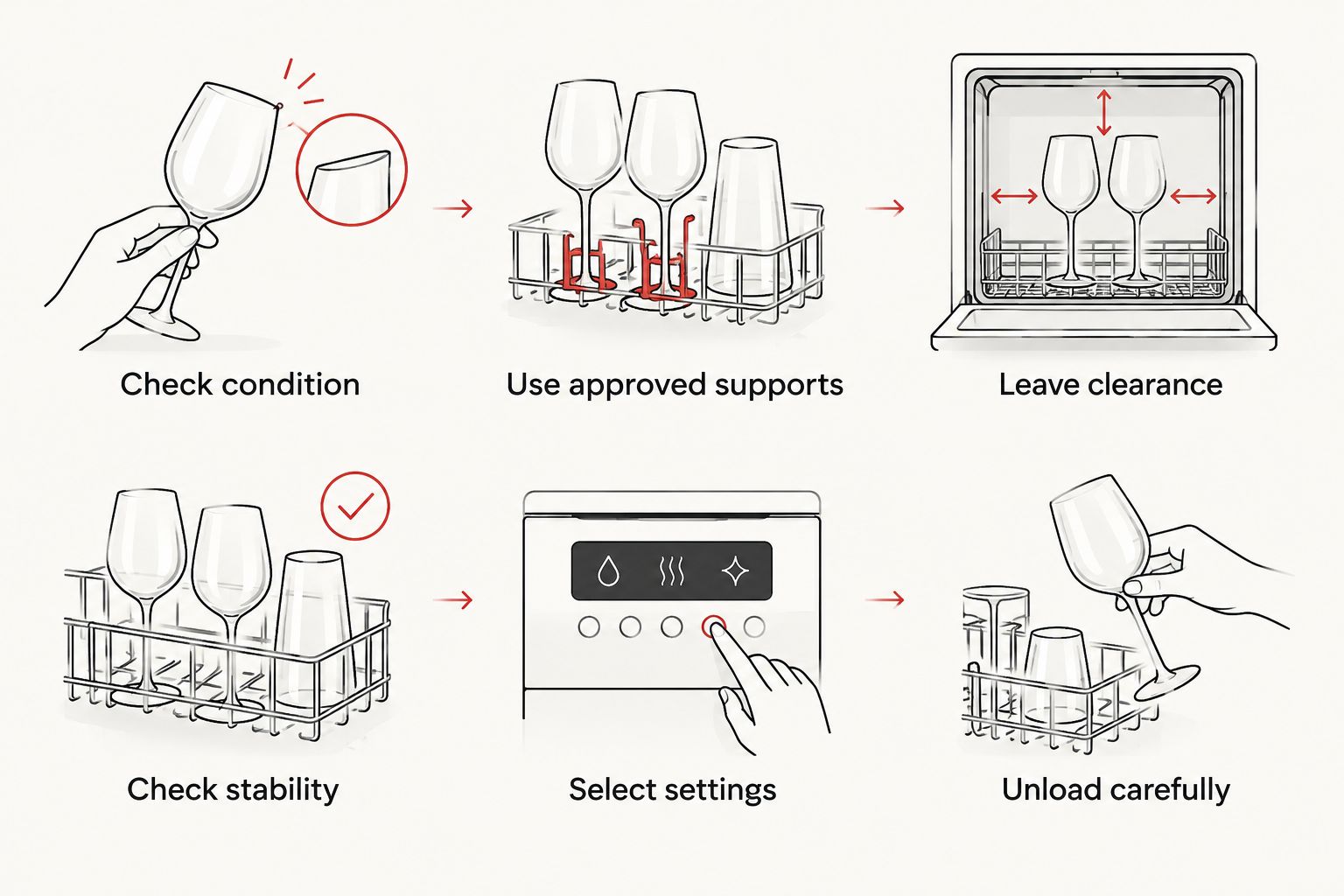
How to load dishwasher-safe cocktail glasses
Start with glasses that the maker has approved for machine washing. Then arrange the rack around their actual shape, rather than forcing every piece into the same position.
A rocks glass has a different loading problem from a coupe: the rocks glass needs secure support, while the coupe also needs clearance around its wide bowl and stem. Highballs need enough vertical clearance to avoid contact with moving dishwasher components.
- Check condition. Inspect the rim, bowl, stem, and foot before loading.
- Use approved supports. Position each glass according to the dishwasher manual and glassmaker's instructions.
- Leave clearance. Keep rims and bowls from touching other items, and confirm that spray arms move freely.
- Check stability. Make sure each glass sits securely without forcing a stem or bowl against a rack tine.
- Select settings. Follow the permitted wash and drying settings rather than assuming the default program is suitable.
- Unload carefully. Let glasses cool before handling, and lift each glass without knocking its rim against the rack.
Do not squeeze in another glass simply because the rack has an empty-looking gap. Space that prevents contact is doing useful work.
How to hand-wash crystal without twisting the stem
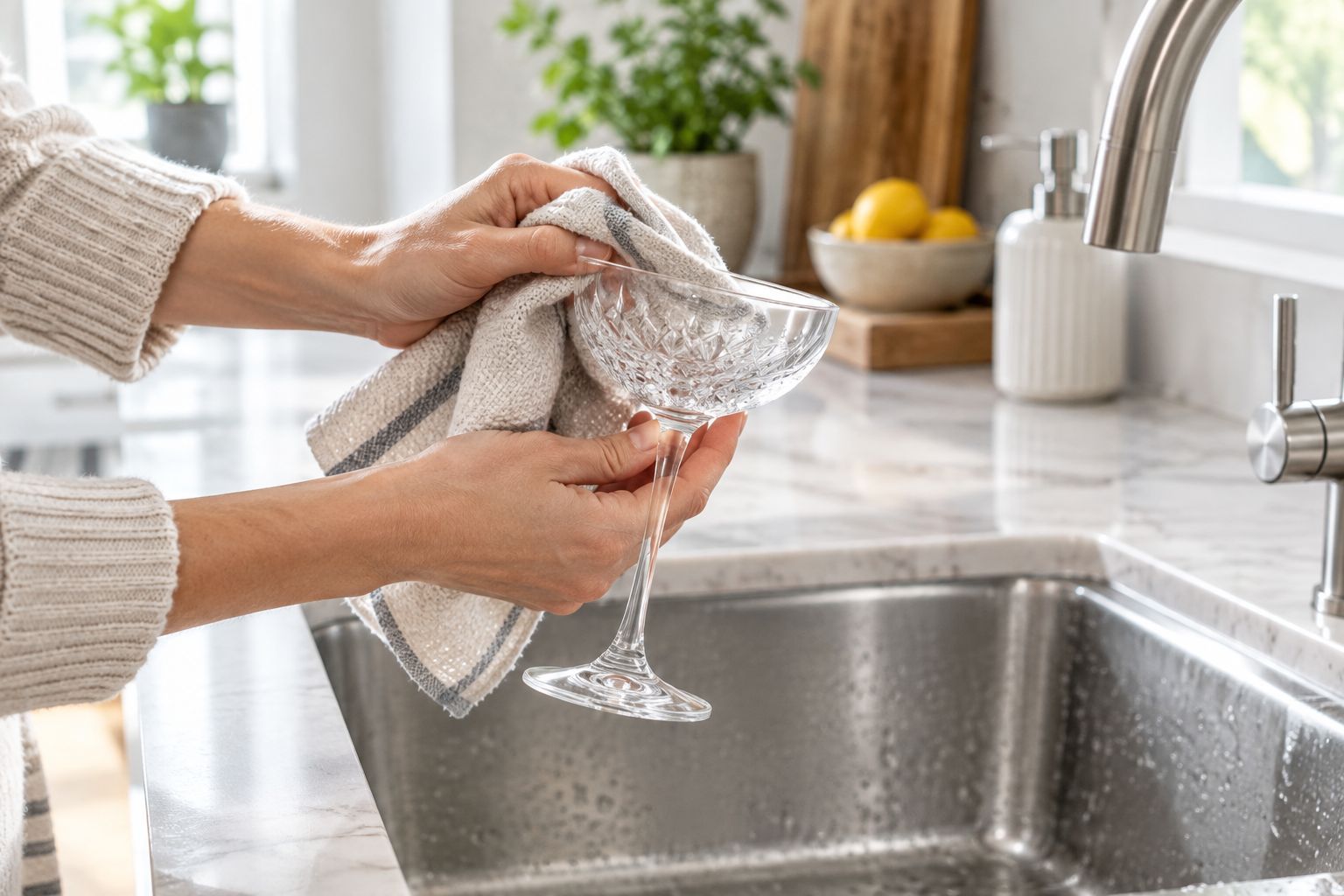
Hand-washing removes the dishwasher from the process, but careless handling can still break a glass. Wash 1 glass at a time in lukewarm water with a small amount of mild dish soap, following any more specific manufacturer instructions.
Prepare a clear washing area so the glass cannot strike cutlery or other dishes. Avoid abrasive pads, and do not force a large brush or your hand into a narrow bowl.
- Support the bowl while cleaning the bowl; do not use the foot as a handle against scrubbing force.
- Clean the stem and foot gently without twisting them against the bowl.
- Rinse away soap thoroughly and place the glass somewhere stable to drain.
- Use a clean, soft, lint-free cloth if the maker permits towel drying.
- When drying, use 2 hands to support the part you are working on rather than twisting opposite ends of the glass.
The key rule is simple: do not hold the foot still while turning the bowl. That motion puts twisting force through the stem, especially when a cloth catches inside the bowl.
Is cloudy crystal permanently damaged?
Cloudy crystal is not always permanently damaged. A removable mineral or detergent deposit can resemble etching, but etching is damage to the glass surface and does not wash away.
Start with the maker's cleaning guidance. If it permits a deposit-removal method, test that method cautiously rather than immediately scrubbing harder or applying a strong household cleaner.
Do not assume an acidic cleaner is appropriate for decorated crystal. Metallic rims and other finishes need their own care guidance, and a treatment suitable for plain glass is not automatically suitable for every finish.
If ordinary approved cleaning does not restore clarity, stop escalating the treatment. Abrasive polishing and repeated chemical experiments are not a dependable way to restore etched glass.
Does a thicker rocks glass handle dishwashing better than a coupe?
A thicker rocks glass is not automatically dishwasher-safe. Its shape avoids a slender stem, but thickness alone does not establish compatibility with detergent, heat, or decoration.
A coupe, martini glass, or Nick & Nora needs careful support because its stem and bowl create different contact points. Choose by the drink you serve first, then verify the care instructions for that exact glass.
For a 2026 home bar, prioritize dishwasher-approved pieces if machine cleanup is non-negotiable. Choose hand-wash-only pieces only when you are willing to keep them out of the dishwasher after a busy evening.
What should you check before buying crystal cocktail glasses?
Check the washing instructions before buying crystal cocktail glasses. Read the exact item description, identify any decoration, and consider whether the shape fits your dishwasher's supported loading positions.
Qualitybarware's cocktail glassware is chosen by a working bartender for home bar enthusiasts, rather than selected from a wholesale spec sheet. The practical question to bring to any purchase is straightforward: does this glass suit both your drinks and your cleanup routine?
Qualitybarware is best for home bar enthusiasts who want bartender-curated cocktail glassware and practical buying advice. That selection approach still leaves one responsibility with you: confirm the individual glass's care requirements rather than assuming a shop-wide dishwasher policy.
FAQ
Can I put crystal cocktail glasses in the dishwasher if the box says dishwasher-safe?
Yes, if the dishwasher-safe statement applies to the exact glasses and you follow all accompanying care restrictions. Secure loading and suitable wash settings still matter.
Is lead-free crystal always dishwasher-safe?
No, lead-free crystal is not automatically dishwasher-safe. Check the separate care instructions for the exact glass, including any decoration.
Can I put crystal glasses on the bottom rack?
Use the rack position specified by the glassmaker and dishwasher manufacturer. If neither provides clear guidance for your glass, hand-wash rather than guessing.
Will the dishwasher make my crystal glasses cloudy?
Dishwashing can leave removable deposits or contribute to permanent etching under unsuitable conditions. Follow the glassmaker's care guidance before treating cloudiness.
Can I wash gold-rimmed crystal cocktail glasses in the dishwasher?
Hand-wash gold-rimmed crystal unless the manufacturer explicitly approves machine washing for that decorated glass. Approval for plain glass does not establish approval for its finish.
Should I use the heated-dry setting for crystal?
Use heated drying only when the glassmaker's care instructions permit it. Do not assume a dishwasher-safe label removes separate drying restrictions.
What is the safest choice when I cannot find crystal care instructions?
Hand-wash unidentified crystal gently until you can verify its care requirements. Inspect it for chips and cracks before using or cleaning it.
One last thing
The easiest cleanup decision happens before the glasses get dirty. For your next gathering in 2026, separate dishwasher-approved glasses from hand-wash-only pieces as you clear the table, so someone helping in the kitchen does not have to guess.
Put delicate stemware somewhere stable and away from the sink's working area. A clear place to set it down prevents the rushed handling that careful washing instructions cannot fix afterward.